
Sicily may not be a part of the mainland but it is as much a part of Italy as any other area in Italy, although Sicilians sometimes like to proudly think of their region as being special, particularly with its separate land mass from the mainland.
Where is Sicily
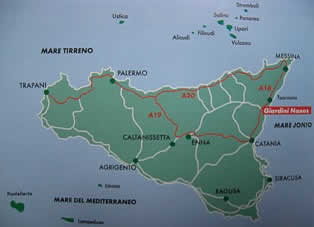
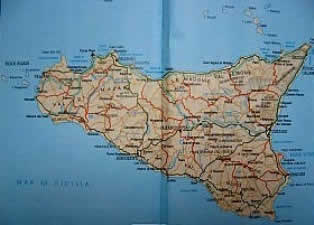
Sicily is the largest island of the Mediterarranean. It is separated from the Italian penninsula by the Straits of Messina a mere 3 km and from Africa about 140 km away by the Siciliy Canal. It can be recognised by its triangular shape. Morphological description and maps of the Sicilian territory show a prevalence of hilly regions over mountainous or flat regions. In a category by it self is Mt Etna at aproximatly 3350 meters the highest peak in the island, the moast important active volcano on the Old Continent and in spite of its apparent isolation, the tue pivot of the contours of the region.
Territory of Sicily
The so-called Sicilian Appenines are an extension of the Calabrian Appenines and can be devided, from east to west into the ranges of the Peloritani, Nebrodi-Caroni and Madonie.
Sicilia being in the centre of the Mediterranean Sea, Sicily has been invaded, during the last 4,000 years by many populations from different parts of Europe (Greeks, Romans, Arabs, Norman, Germans, French Spanish and others). Thus, there are swarthy people with dark eyes and dark hair or with blue or green eyes and fair hair and skin and even some red haired people.
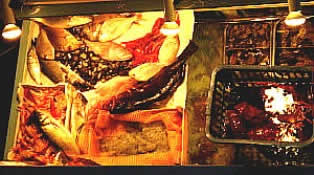 Food in Sicily
The variety and complexity of the culinary art in Sicily is the result of thousands of years of history, the amassing over the centuries of innumerable different layers of civilization and culture. While Sicilian cuisine is already rich an elaborate in itself, contributions to it from distant places are not to be neglected. There is, in fact, in almost every dish some ingredient from outside the island; the influences may be Greek, Latin, Arab-Norman, Franco-Hispano-Bourbon.
The ancient Greek roots of this cuisine, celebrated by various authors of the period (Trimalchio of Syracuse, Atheneus, Archestratus of Gela), are revealed in simple, natural foods consisting basically of very fresh fish and natural herbs, since special spices and condiments still had to be imported. The Greek cuisine remained true to itself during the time of the Roman occupation, when the island was the 'granary' of the Empire.
The Greek gods in Sicily
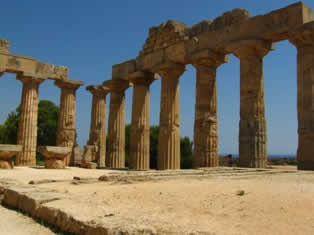
ACIS: god of the river of the same name and lover of Galatea (see ACIREALE). ALEOLUS: son of Poseidon, god of the winds and lord of Aeolian Islands. ALPHEUS:god of the river of the same name in the Peloponnese. He fell in love with the water nymph Arethusa and followed her to Sicily (see SIRACUSA). APHRODITE: (Venus): goddess of love and wife oh Hephaestus, much worshipped in Erice. CHARYBDIS: a monster who inhabited the Sicilian shore of the Straits of Messina. Three times a day the monster swallowed huge amounts of water, creating dangerous whirlpools, including one which trapped Ulysses' ship. COCALUS: Sicilian king who offered refuge to Dedalus; the latter was pursued by Minos after helping Theseus to escape from Minos' labyrinth (see p 127). DEMETER (Ceres): goddess of the harvest, who fought with Hephaestus for control of Sicily. ERYX: son of Aphrodite and Butes (or Poseidon). He challenged Heracles and was killed by him. ETNA: a Sicilian nymph who intervened in the dispute between Demeter and Hephaestus over the possession of Sicily. One legedn recounts that the Palici were born her union with Hephaestus. GALATEA: a nymph who was loved by the monster Polyphemus and was in love wihth Acis (see ACIREALE). GIANTS: son of Gaia (the Earth) and Uranus, enemies of the Olympic gods, and particualarly of Zeus and Athena. HADES (Pluto): brother of Zeus; lord of the kingdom of the dead. He abducted Demeter's daughter, Proserpina, on the banks of Lake Pergusa. HELIOS: god of the sun. He owned a herd of cattle in Sicily, some of which were eaten by Ulysses' companions, thus incurring the wrath of the god. HEPHAESTUS: god of fire and lord of the volcanoes, in which he worked with his helpers, the Cyclops. HERACLES: a hero during his earthly life and a god after his death. One of his 12 Labours, that of the cattle of Geryon, took place in Sicily. PALICI: twin sons of Zeus and the muse Thalia or, according to another tradition, oh Hephaestus and Etna, born in the waters of Lake Naftia, near Palagonia. PERSEPHONE(Proserpina): goddess of the Underworld and wife of Hades. TYPHON: a giant who fought with Zeus and Athena. He escaped by crossing the Sicilian sea, but was then crushed when Zeus hurled the island of Sicily on top of him.
As well as the dishes already mentioned, the following are typical of Sicilian cuisine: as hors d'oeuvres, stuffed tomatoes, vegetable caponata, stuffed or crushed olives; as first course, pasta with sardines, pasta 'ncasciata, pasta A la Norma, crispeddi, sfincioni. As main and side dishes we should mention swordfish A la ghiotta, aubergines prepared in various ways, sardines a beccafico, broccoli affogati, falsomagro and a great varety of cheeses, from pecorino to tuma to primosale. From the vast array of sweets and cakes we will mention cannoli, frutti di Martorana, agnello pasquale, pignolata and a great variety of granite.
Sicilian wines are many different kinds and undoubtedly of high quality, pure and strong with a punch in them and often a touch of Marsala quality. As well as the various types of Marsala, we will mention Bianco di Alcamo, Regaleali, Corvo di Salaparuta, various kinds of Moscato and Passito (Pantelleria), the excellent wines of the Etna district (white, rose and red), Malvasia delle Lipari, Ambrato di Comiso and Faro di Messina.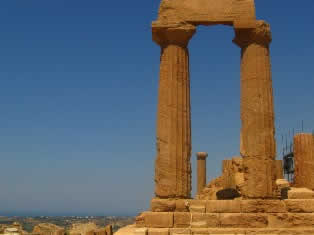 The use of chick- peas with pasta, dressed with oil or in other combinations, recalls the events connected with the revolt of the Sicilian Vespers. It is to the Spanish who ruled Sicily from the fifteenth to the eighteenth century that Sicilians owe the introduction of raw materials and condiments from the New World, as well as typically Spanish food customs. With the importation of peppers, tomatoes, auberigines and potaotes, new tastes were added to the cuisine already existing, giving rise to new blends of foods and combining well chosen ingredients, while at the same time Hispanic usages and customs still deeply rooted in the life of the Sicilians were spreading. In the age of the Bourbons it was the turn of the haute cuisine of the nobles and priests, which created its own version of the simple, popular food of the island traditions, while maintaining its ancient splendours.
Legend of Sicily
Legend relates how Alpheus, god of the river Alpheus in the Peloponnese, was wandering across the greek region of Arcadia, when he came across Arethusa, one of Artemis water nymphs. The river god fell in love with the nymph, but as he tried to seize her, she changed into a stream, slipping from him into Ionian Sea only remerge as a spring in Siracusa. Alpheus pursued Arethusa to Sicily, where his waters mingled with those of the nymph. This myth, diffused among the Greek population of Sicily, was taken to symbolise the transference of the Greek civilisation from the motherland to Sicily.